 KODAMA
 What’s real, shown
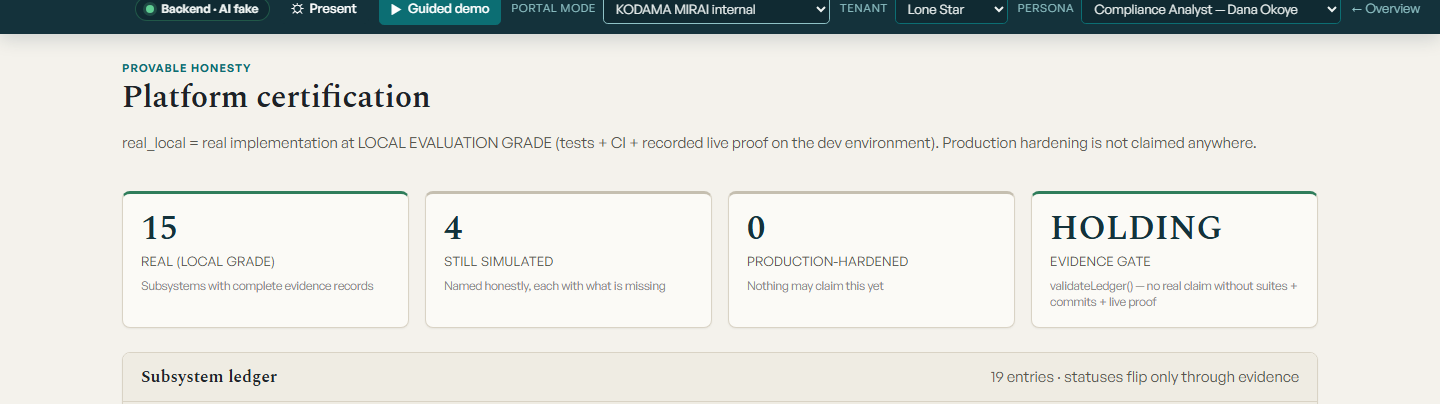
Our development process gates every “this works” claim behind evidence — test suites, commits, and live proof — before we’re allowed to call it real. This page applies the same standard to what we say publicly: dated milestones, real product output, and a standing offer to show you any of it live.
What works today
- Documents go in — regulatory PDFs, policies, spreadsheets — and come out searchable with citation-accurate locators (the page, the paragraph, the cell an answer points to).
- Questions come back as answers with numbered citations into those documents. Every citation is checked against the retrieved passages before the answer is shown; drafts that fail validation are rejected and recorded, never displayed as answers.
- When the corpus can’t support an answer, the Workbench refuses and names the missing evidence. A refusal is recorded exactly like an answer.
- Every AI output is preserved with its question, its exact source passages, and the model invocation that produced it — immutably, at generation time.
- Approved work rides a reviewer workflow with a hash-chained audit trail, and evidence packs export as PDFs.
- An IT general controls content library — control-test specifications authored by our founder’s practice — is loaded and citable inside the product.
Milestones
- Workbench v1 complete — full pipeline verified end to end behind the evidence gate: ingestion, cited answers, human review, evidence-pack export.
- ITGC content library integrated — 45 control-test documents imported with full provenance, powering obligation-mapping answers.
- Real sign-in and real documents — credentialed identity, sessions, and a live regulatory corpus (FFIEC IT Handbook, NIST CSF 2.0, 12 CFR 30) replaced every simulated stand-in.
- Kodama Hub in production — our ERM platform live for customer use behind protected sign-in.
- Kodama Mirai goes public — first version of this site published; brand domain live June 2026.
An evidence pack, annotated
This is real product output: an evidence pack the Workbench generated from its demonstration environment. The data is synthetic — the structure, citations, provenance, and audit trail are exactly what the product produces. You’ll notice the pack labels its own demo posture inside the document (down to flagging that the demonstration ran on a deterministic stand-in model): the product refuses to let any output overstate itself, and that includes this example.
What to look for inside:
- The work product itself — the reviewed answer with its citations, each carrying a quoted excerpt from the source document.
- AI provenance — which model ran, a fingerprint of the prompt template, and a cryptographic hash of every passage the answer relied on, frozen at generation time.
- Version history and audit trail — who did what, in what order, with the review outcome on the record.
Download the example pack (PDF, synthetic data)